
Starting your journey in Gran Turismo 7 can be an exciting experience. The game offers hundreds of cars, a huge selection of tracks, detailed tuning options, different racing categories and plenty of ways to improve your driving. At the same time, the amount of content can be overwhelming when you are just getting started. There is a lot to learn, and some mistakes that seem harmless at first can make the early stages of the game much more difficult than they need to be.
The good news is that most beginner mistakes are easy to avoid once you understand how the game works. You do not need to be an experienced racing driver to make progress. What matters most is learning the fundamentals, understanding your car and resisting the temptation to rush through everything.
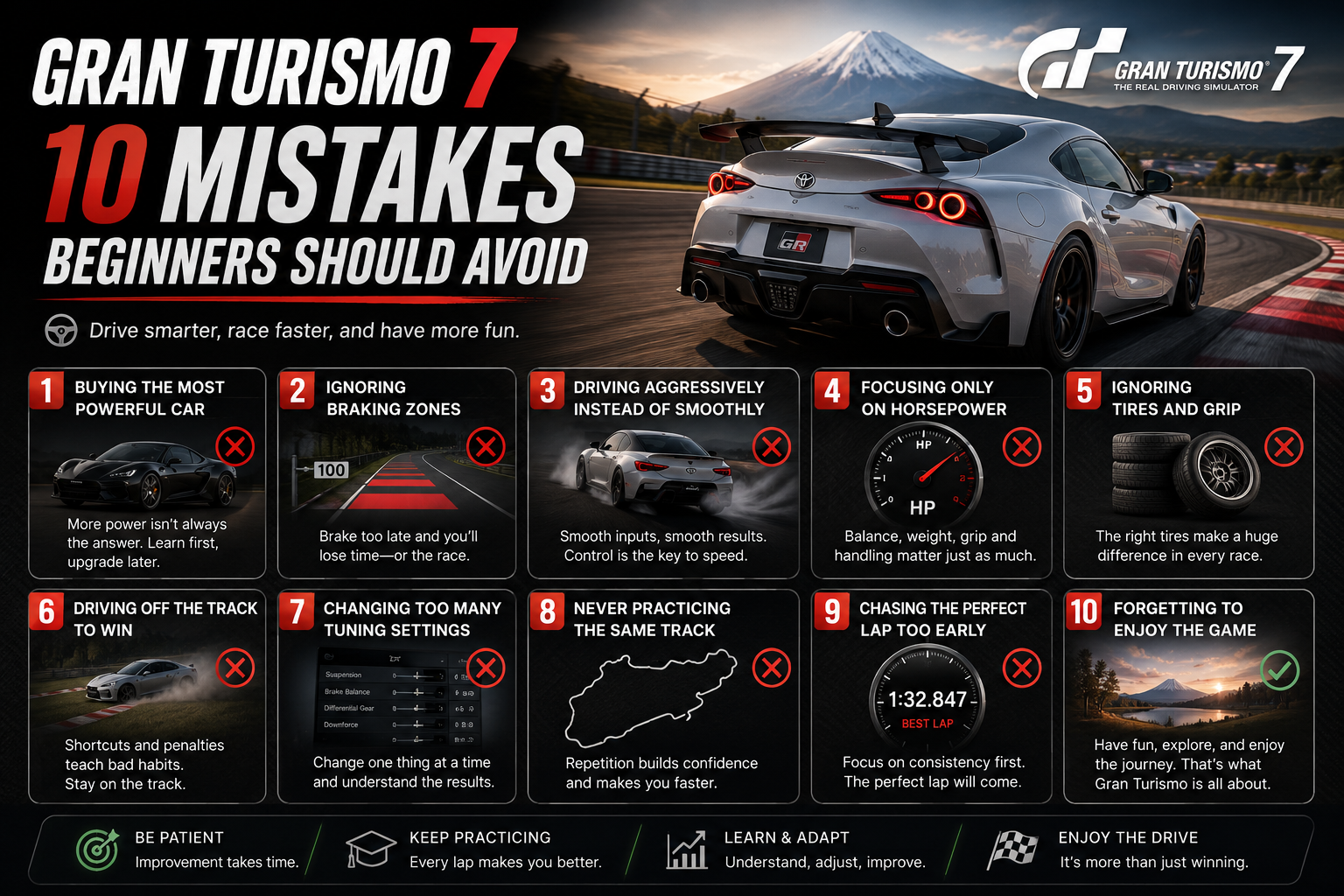
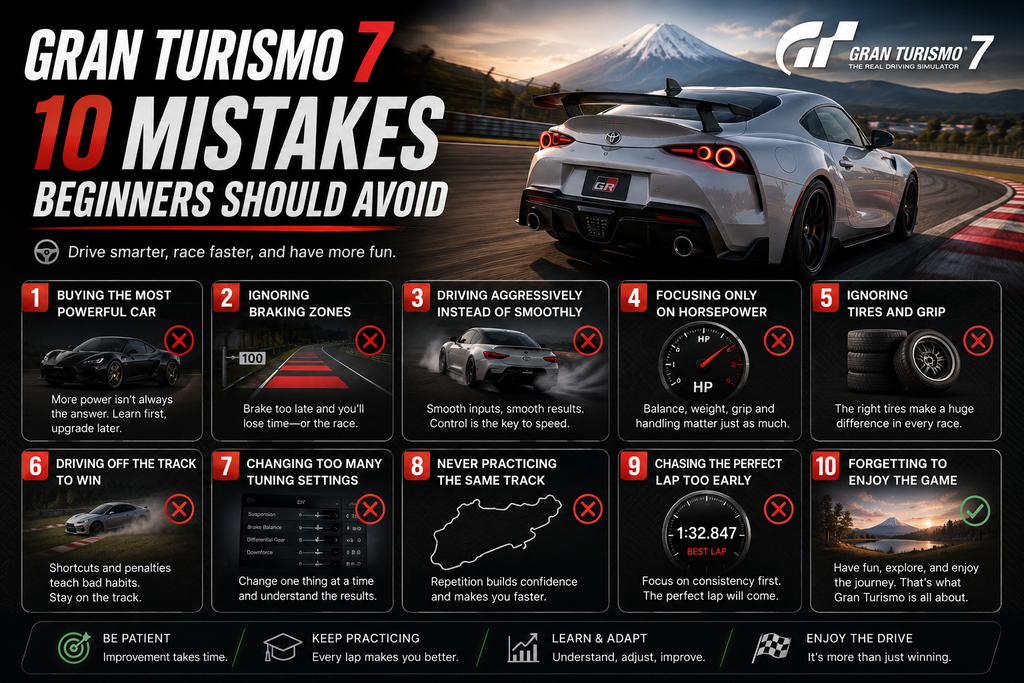
Here are ten common mistakes beginners should avoid in Gran Turismo 7.
1. Buying the Most Powerful Car You Can Afford
One of the first things many new players want to do is save enough credits to buy an incredibly fast car. It is understandable. Seeing a powerful supercar in the dealership naturally makes you want to put it in your garage immediately.
However, buying the fastest car available is rarely the best strategy.
A car with enormous horsepower can actually make learning more difficult. More power means that mistakes happen faster, braking zones become more demanding and throttle control becomes increasingly important. If you are still learning how to take corners, a high-performance car may hide the real problem rather than solve it.
Instead, choose cars that are balanced and predictable. A moderately powerful sports car can teach you much more about braking, cornering and acceleration than an extremely powerful machine.
As your driving improves, you can gradually move toward faster cars. When you eventually return to that supercar, you will have the skills necessary to use its performance properly.
2. Ignoring the Braking Zones
Braking is one of the most important parts of racing, yet beginners often focus almost entirely on acceleration.
It is easy to look at a long straight and think about how quickly you can reach maximum speed. But the real challenge begins when you arrive at the next corner.
Braking too late is one of the most common reasons beginners run wide. You approach the corner at full speed, hit the brakes too late and then have no choice but to turn while carrying far too much speed. The result is usually a missed apex, a trip beyond the track limits or a major loss of momentum.
Instead of immediately trying to brake later, focus on finding a braking point that you can repeat consistently. Look for signs, distance markers, kerbs or other objects beside the track that can act as references.
Once you are comfortable braking at the same point every lap, you can gradually experiment with braking later.
3. Driving Aggressively Instead of Smoothly
Another common beginner mistake is believing that faster driving means more aggressive driving.
New players often turn the steering wheel sharply, slam on the brakes and immediately apply full throttle as soon as they reach the corner exit. While this can feel fast, it frequently produces slower lap times.
Smooth inputs are usually much more effective.
Try to brake firmly but progressively release the brakes as you approach the corner. Make a controlled steering input rather than constantly correcting the car. When you reach the exit, gradually increase the throttle as you straighten the steering.
The objective is to keep the car balanced.
A smooth lap may not feel as dramatic as an aggressive one, but watch the stopwatch and you may discover that the smoother approach is significantly faster.
4. Focusing Only on Horsepower
Horsepower is one of the easiest specifications to understand when looking at a car. Bigger numbers look impressive, and more power usually means better acceleration.
But racing performance involves much more than engine output.
Weight, tires, braking performance, suspension, aerodynamics and drivetrain layout all influence how a car behaves. A lighter car with less horsepower can sometimes be much easier and more enjoyable to drive than a heavy car with significantly more power.
This becomes particularly important when choosing cars for different events.
Instead of asking only, “How much horsepower does this car have?”, consider how it handles corners, how quickly it stops and how easily you can control it.
The fastest car on paper is not necessarily the fastest car for you.
5. Ignoring Tires and Grip
Tires are often underestimated by beginners, even though they have an enormous influence on the behavior of a car.
Different tire compounds provide different levels of grip, and the right choice can dramatically change how a vehicle feels. More grip can improve braking, cornering and acceleration, while less suitable tires can make the same car feel unpredictable.
It is also important to understand that having more grip does not eliminate the need for good technique. Even a well-equipped car can lose traction if you enter a corner too quickly or apply too much throttle.
Pay attention to how your tires behave during a race. If the car begins feeling less stable, takes longer to stop or starts sliding more easily, your available grip may be changing.
Learning to understand tire behavior is an important step toward becoming a faster and more consistent driver.
6. Trying to Win Every Race by Driving Off the Track
When a race becomes difficult, beginners sometimes start taking shortcuts, cutting corners or using the track limits aggressively.
While finding a faster racing line is part of the game, repeatedly leaving the intended racing surface can lead to penalties and, more importantly, teaches bad habits.
Instead, learn to use the available track properly.
Use the width of the circuit to your advantage, especially when entering and exiting corners, but keep control of the car. The ideal racing line is usually about creating the smoothest possible path rather than simply cutting as much of the corner as you can.
This is especially important because good habits developed during practice will carry over into more difficult races later.
7. Changing Too Many Tuning Settings at Once
Gran Turismo 7 gives players a huge amount of control over vehicle setup. You can modify suspension, brakes, transmission, tires, aerodynamics and many other aspects of your car.
This is one of the game’s greatest strengths, but it can also confuse beginners.
If you change five or six settings at the same time and the car suddenly feels better or worse, you will not know which adjustment caused the difference.
A much better approach is to make small changes one at a time.
If the car feels unstable under braking, investigate the areas that influence braking and stability. If it struggles to turn into corners, experiment with appropriate handling adjustments. Drive several laps after each change and compare the results.
Tuning becomes much easier when you treat it as an experiment rather than randomly changing numbers.
8. Never Practicing the Same Track
Some players constantly move from one event to another because they want to experience as much content as possible.
That is fun, but it can slow down your development as a driver.
Repeatedly driving the same circuit allows you to learn its details. You begin to remember braking points, understand corner sequences and recognize where you can safely carry more speed.
After several laps, you stop thinking about where the track goes and can instead focus on improving your technique.
Try spending extra time on circuits that you find difficult. The track that initially feels frustrating can eventually become one of your strongest circuits.
Every lap gives you another opportunity to understand something new.
9. Chasing the Perfect Lap Too Early
It is tempting to compare your lap times with other players and immediately try to find every possible tenth of a second.
However, chasing perfection before developing consistency can be counterproductive.
Imagine setting one incredibly fast lap but making several mistakes during the next five attempts. You may have achieved a great time, but you have not yet learned how to reproduce it.
Instead, focus on consistency.
Try to complete several clean laps within a small range of your best time. Once you can repeatedly achieve that pace, start looking for small improvements.
Maybe you can brake five meters later at one corner. Perhaps you can carry slightly more speed through another. Maybe your exit from a slow turn can be improved.
Small improvements eventually add up.
10. Forgetting to Enjoy the Game
Perhaps the biggest mistake a beginner can make is treating Gran Turismo 7 like a constant competition against the stopwatch.
Of course, improving lap times is incredibly satisfying. But Gran Turismo 7 offers much more than simply trying to become the fastest driver possible.
Take some time to explore different cars. Try vehicles you would normally ignore. Drive classic racing machines, Japanese sports cars, European performance cars and American muscle cars. Experiment with different tracks and discover which combinations you enjoy most.
You do not have to be setting world-record lap times to have fun.
Sometimes the most memorable moments come from simply taking a favorite car onto a beautiful circuit and enjoying the drive.
Final Thoughts
Gran Turismo 7 has a learning curve, but you do not need to master everything immediately. The most important thing is to build good habits from the beginning.
Avoid chasing horsepower for its own sake. Learn your braking points, practice smooth steering and throttle control, understand how tires affect your car and spend time learning individual circuits. When experimenting with tuning, make small changes and give yourself enough time to understand the results.
Most importantly, be patient.
Your lap times will not improve dramatically overnight, and that is perfectly normal. Every mistake teaches you something about the car and the track. With enough practice, actions that once required conscious thought will eventually become natural.
The real satisfaction of Gran Turismo 7 comes when you notice that a corner that once seemed difficult suddenly feels effortless, or when you realize that you have improved your lap time without even pushing harder.
Drive smoothly, learn from your mistakes, and keep practicing. The speed will come.